
McDonough County Court Records After a Jail Arrest
After an arrest in McDonough County, booking happens at the jail, and the court record begins when the State's Attorney files charges. The prosecutor reviews the police reports and decides whether to charge, what to charge, and how. Those filed charges, not the arrest paperwork, become the official court record for the case. The McDonough County Circuit Clerk keeps that record, and the case moves through the Ninth Judicial Circuit at the courthouse on Courthouse Square in Macomb.
It helps to separate the two sides. The booking and custody side lives with the sheriff, and you can read about it on the jail inmate records page, with booking photos covered on the jail roster mugshots page. The court record after an arrest is the charging side: the charges the prosecutor filed and everything the court does with them. The rest of this page covers how to find and read those court records.
How to Find McDonough County Court Records After an Arrest
McDonough County court records run through the Circuit Clerk and the Judici case-search system. The Ninth Judicial Circuit links its "Search Cases" tool to Judici, and the Circuit Clerk links the daily court schedule there too. Judici is operated by a private company, not the court, and it sits behind a captcha gate, so plan to clear that step before reaching the case fields.
- Open the McDonough County case search at Judici and clear the captcha gate.
- Search by the defendant's name or by the case number.
- Open the case and read the charge list and the docket entries.
- Check each charge's level, status, and any disposition that has been entered.
The Judici case-search page for McDonough County is shown below. You can reach it through the McDonough County Judici case search.
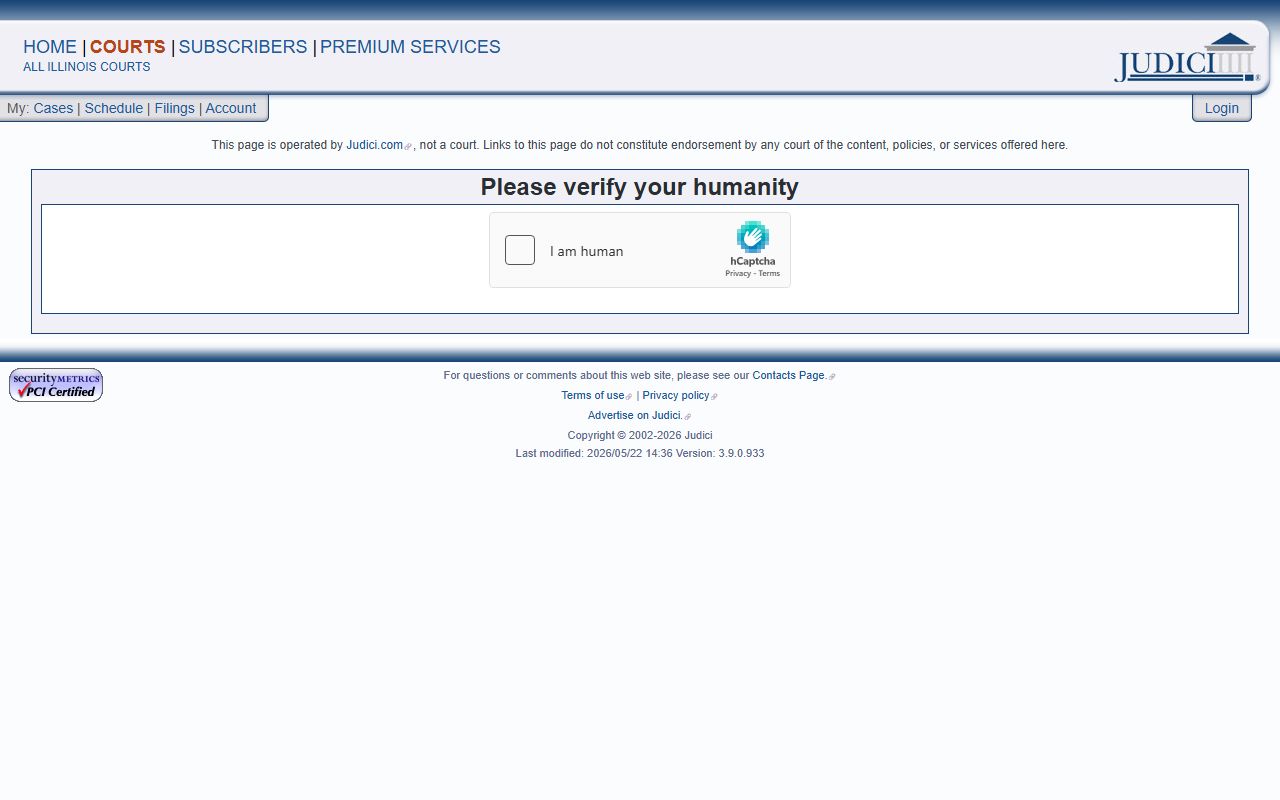
The captcha that guards the search means automated lookups are blocked, so the documented entry fields are limited to the gate itself.
| Field Label | Type | Notes |
|---|---|---|
| Verify your humanity | Captcha | Gate shown before the case fields |
| Continue | Submit button | Appears after the captcha clears |
| Case search fields | Text | Name and case-number search open after the gate |
For official copies or older cases, contact the McDonough County Circuit Clerk directly. The Circuit Clerk page, pictured below, lists the clerk's duties and links to Judici and expungement information. You can view it at the McDonough County Circuit Clerk page.
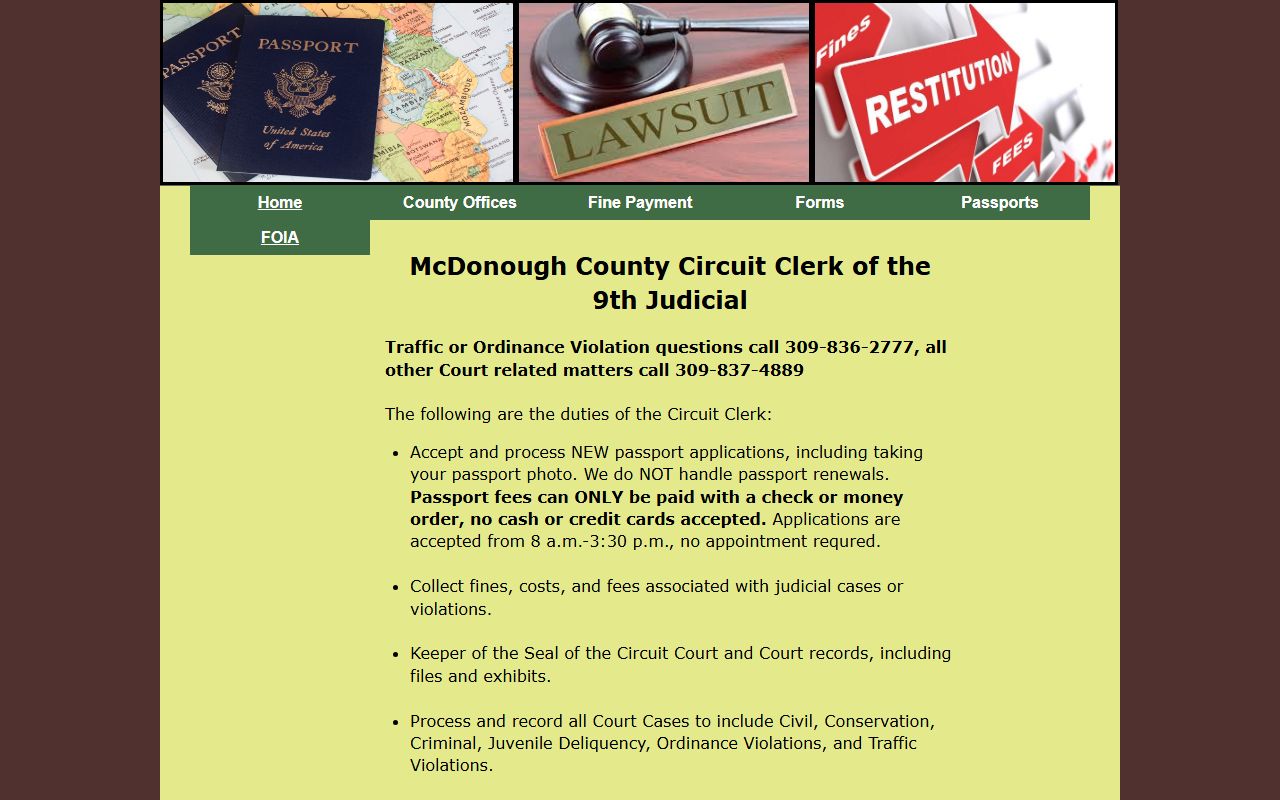
A statewide remote system, re:SearchIL, exists for case documents, but it requires registration and limits public access, so the Circuit Clerk or Judici is the practical starting point.
How Charges Get Filed After an Arrest
The court record opens when the prosecutor files a charging document. There are three main types in Illinois, and the one used depends on the seriousness of the offense and how the case is brought. A booking at the jail does not by itself create the formal charge. That step happens when the State's Attorney files.
| Complaint | Information | Indictment | |
|---|---|---|---|
| Filed By | Officer or prosecutor | Prosecutor | Grand jury |
| Common For | Misdemeanors | Many felonies | Serious felonies |
| Starts | The case | The case | The case |
Once filed, the charging document sets what the court will address at the next hearing. It can be amended as the case develops.
Charge Status and What It Means
Charges change as a case moves. The prosecutor can amend, reduce, add, or drop counts, and a charge can be dismissed entirely. The booking charges listed at the jail can differ from what the prosecutor finally files, which is one more reason the court file controls. The terms below show up often in a McDonough County case record.
| Status | What It Means |
|---|---|
| Pending | The charge is open and the case is still moving through court. |
| Amended or Reduced | The prosecutor changed the charge, often to a lesser offense. |
| Dismissed | The charge was dropped and is no longer being pursued. |
| Nolle Prosequi | The prosecutor formally declined to proceed on the charge. |
Note: A jail or arrest record may show the original booking charges, while the court file shows the charges the prosecutor actually filed and pursued.
The State's Attorney and the Court Record
Illinois uses State's Attorneys rather than district attorneys. The McDonough County State's Attorney, Matthew P. Kwacala, is the chief prosecutor and represents the People of the State of Illinois in criminal cases in the county. Assistant State's Attorneys Susan M. Maxwell and Kevin Kanzler help carry that work. The office reviews law-enforcement reports, decides what to charge, and represents the state through detention, plea, trial, and sentencing.
The State's Attorney page, shown below, lists the prosecutor's role and contact details. You can view it at the McDonough County State's Attorney page.
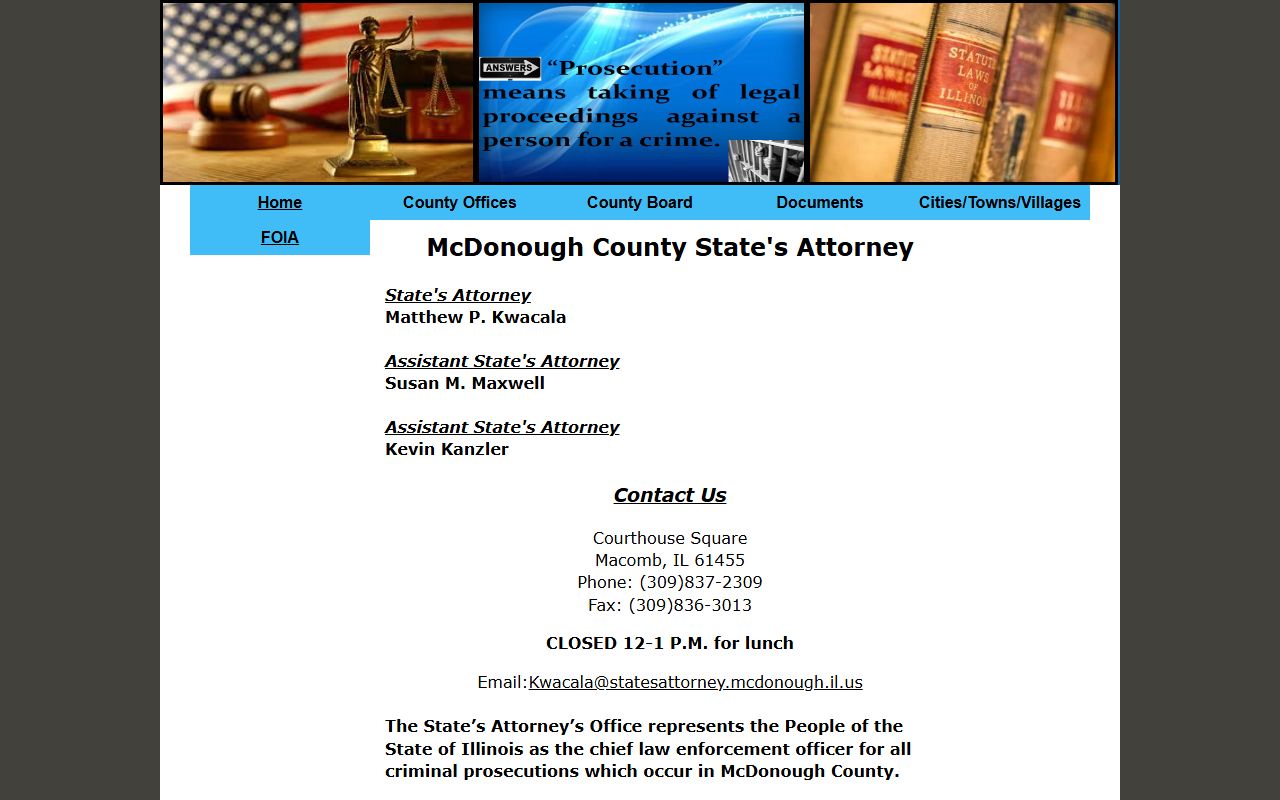
Because the prosecutor controls charging, the court file is the place to confirm what someone actually faces, not the arrest paperwork.
Release After an Arrest in McDonough County
Illinois changed how release works. Under the Pretrial Fairness Act, the state ended cash bail for most cases on September 18, 2023. Instead of posting money, release is now decided by the court under the pretrial release and detention framework in the Code of Criminal Procedure. The prosecutor may ask the court to detain a person on statutory grounds, and the court decides whether to release with conditions or hold the person pending the case.
| Term | How It Works |
|---|---|
| Pretrial release | The court decides whether a person can be released under conditions. |
| Detention | The prosecutor may seek detention on statutory grounds; the court rules. |
| Conditions of release | May include no-contact orders, travel limits, or monitoring. |
| Hold or detainer | A warrant, sentence, or another agency can keep someone in custody even if one case resolves. |
Old warrant lists still show a bond column because older cases carry historic terms, but that does not mean a newly arrested person posts cash at the jail. Confirm release details with the jail and the Circuit Clerk.
Warrants That Lead to an Arrest
An outstanding warrant is a common path into the jail. The McDonough County Sheriff and Crime Stoppers publish an active warrant list as a PDF, with columns for name, sex, race, date of birth, city, charge, bond, and case number. The page warns that a listed warrant may already have been served, dismissed, or adjudicated, so the list is a lead, not proof of current custody. To check the underlying case, use Judici or the Circuit Clerk. To confirm whether a person is actually in custody after a warrant arrest, call the jail at 309-833-JAIL (5245).
Charges vs. Convictions
Being arrested and charged is not the same as being convicted. A charge is an accusation. A conviction is the result of a plea or a verdict. Both can appear in a public court record, which is why reading the case status matters before drawing any conclusion.
| Charge | Conviction | |
|---|---|---|
| Stage | Accusation | Verdict or plea |
| Burden of Proof | Probable cause | Beyond a reasonable doubt |
| Public Record | Yes | Yes |
Sealed vs. Expunged Records After an Arrest
Illinois law lets eligible people clear a record after a dismissal or an eligible outcome. The expungement and sealing statute sets the petition process, which is filed in the court where the charges were brought. The Circuit Clerk page links local expungement information. Sealing and expungement are not the same, and the difference matters for who can later see the record.
| Sealed | Expunged | |
|---|---|---|
| Visibility | Hidden from public view | Destroyed or treated as if it never existed |
| Law Enforcement | Limited access remains | Very limited access |
| Eligibility | Set by 20 ILCS 2630/5.2 | Set by 20 ILCS 2630/5.2 |
You can read the petition rules in 20 ILCS 2630/5.2.
Getting Official Court Records After an Arrest
Judici is useful for a quick look, but it is not the court. For an official copy of a charge, a disposition, or a case file, the McDonough County Circuit Clerk is the source. The clerk, Ian Fischer, keeps the court records at #1 Courthouse Square, Macomb, IL 61455, and can be reached at 309-837-4889. The courthouse is open 8 a.m. to 4 p.m., and an e-filing kiosk sits on the first floor in the clerk's office. The Illinois Courts directory adds that a law library and self-help center are on the third floor, language access is available with notice, and free parking is allowed on all four sides of the courthouse.
The Ninth Judicial Circuit, pictured below, links the case search and the McDonough County courtroom information in one place. You can view it at the Ninth Judicial Circuit homepage.
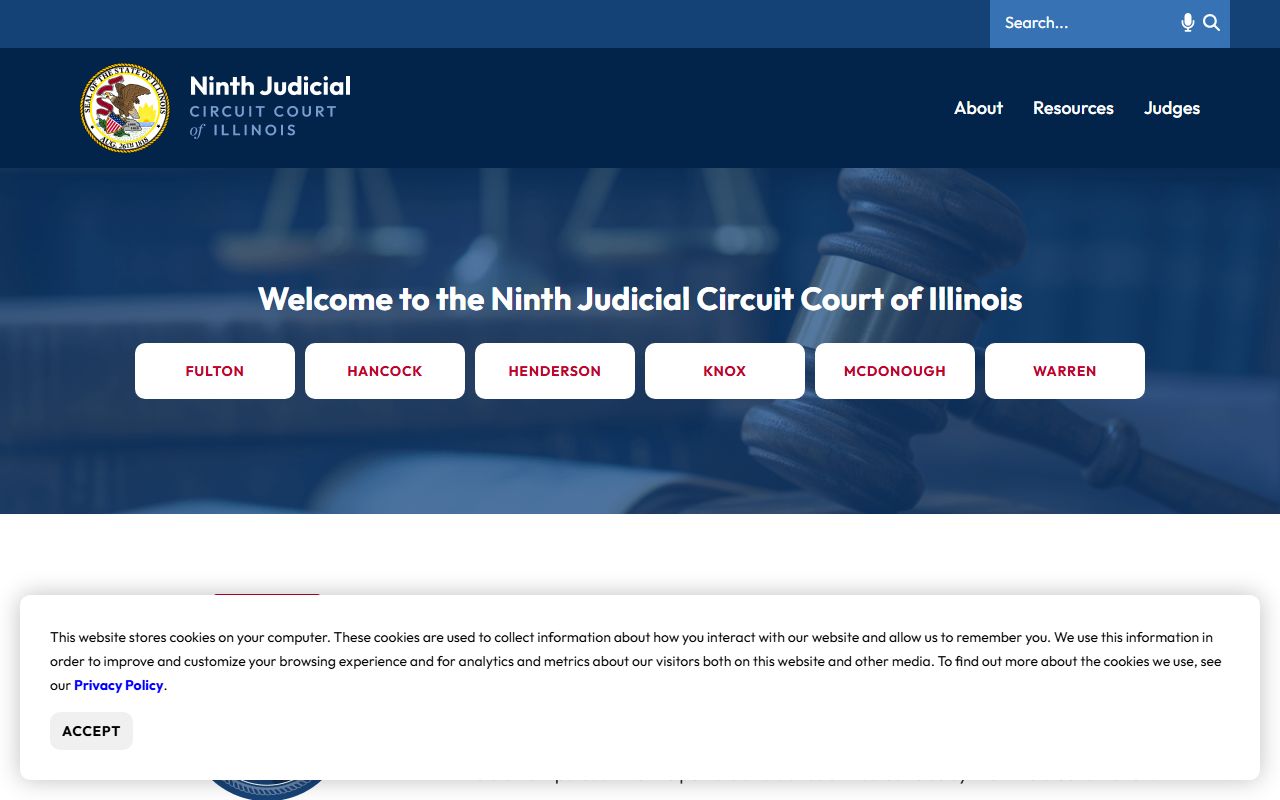
The directory page itself, run by Illinois Courts, lists the courthouse hours, resources, and the Circuit Clerk link. You can reach it at the McDonough County Circuit Court directory. For records the clerk cannot release, the open-records law provides a written request route.
Background Check Considerations
A casual court-record lookup is not the same as a regulated background check. Formal screening for jobs, housing, or credit must follow the federal Fair Credit Reporting Act and use a licensed consumer reporting agency. A public case search does not meet that standard and should not be used for those decisions.
Important: This site is not an FCRA-regulated consumer reporting agency, and its information may not be used for employment, housing, credit, or insurance screening.
Restricted Court Records After an Arrest in McDonough County
Not every court record after an arrest is open. Juvenile cases, sealed and expunged matters, and some dismissed charges may be withheld from public view. Records tied to an ongoing investigation can also be held back under the open-records law. The statewide remote system applies its own limits to expunged, impounded, confidential, and sealed records. When a case does not appear online, the Circuit Clerk can explain whether it is restricted or simply not posted.